

 ClikPick
 Find Programs
 Top Universities
 ClikPick
 About Us
 Career
 Blogs
Blogs Scholarships


Which MBA suits you: Online, Offline, or Distance?

Academic Guidance • Thu Apr 30 2026
Online MBA suits working professionals who want flexibility and UGC-DEB recognised degrees while continuing their jobs. Offline MBA is best for fresh graduates seeking campus experience and strong placement networks. Distance MBA is the most affordable option for self-paced learners with maximum schedule freedom. Your choice depends on three factors: current employment status, budget, and need for classroom interaction.
Why Choosing the Right MBA Mode Matters in 2026
Choosing between an online, offline, or distance MBA is one of the most consequential decisions for your career. Each format has a different fee structure, flexibility level, and eligibility requirement and picking the wrong one costs you time and money. This guide breaks down all three so you can decide clearly.
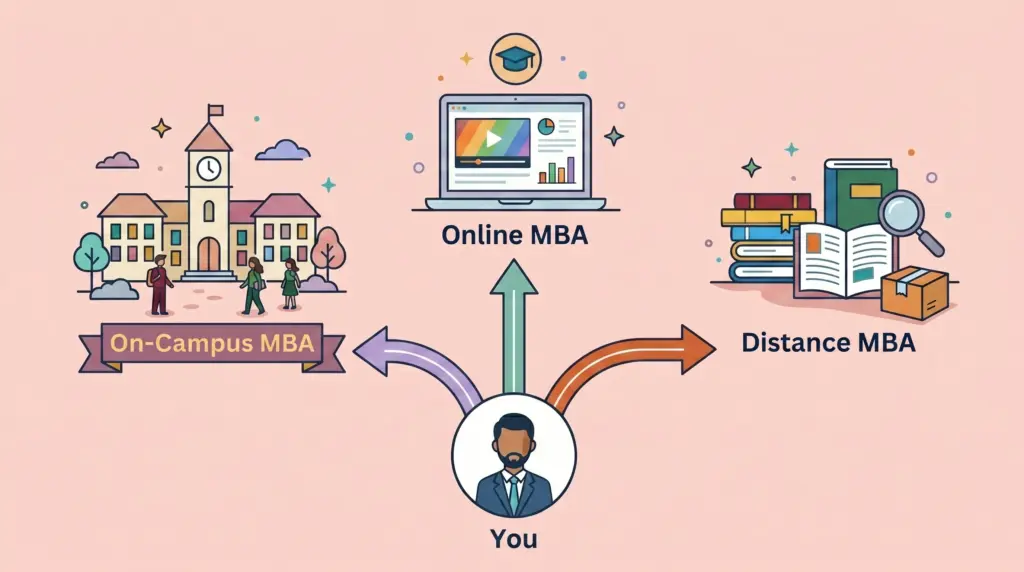
Sounds relatable?
You must know that the ‘one-size-fits-all’ MBA does not work in a modern industry setting. Hence, you need to be careful before picking the right MBA program. The real advantage is that the technology has evolved, which has led to the introduction of 3 key modes to get your MBA degree: online, offline, and distance.
However, having the right knowledge about these is necessary, because picking the wrong one could be a costly mistake. Which is why you need an expert’s advice to choose which MBA suits you best - online, offline, or distance.
In this blog, you’ll explore the value and scope of pursuing an MBA, and the different ways to pursue it, covering offline/on-campus, online, and distance MBA. This will help you make the right decision to opt for the right MBA program.
First, Ask Yourself: What Do You Need From an MBA?
Before choosing the course, you must take a moment to think about a few things-
- Are you a fresh graduate looking for campus exposure?
- Are you a working professional who cannot leave your job?
- Do you want flexibility or structured classroom learning?
- Is networking and campus life important for you?
Your answers will make the decision much easier.
On-Campus MBA: What It Is and Who Should Choose It
On-Campus/Offline MBA programs are the traditional way of pursuing your master's degree, where you attend the classes on campus. Here, you attend classes in person at the university, allowing for real-time interaction with professors and classmates who bring years of academic and industry expertise to your learning.
Pros and Cons of Pursuing an On-Campus/Offline MBA
Pros of an On-Campus MBA:
- Live Interactive Learning: Live chats, case studies and peer learning help in making concepts more understandable and practical.
- Broader Perspective: When you interact with a variety of classmates, you have a chance to learn not only through books, but through real experiences.
- Good Networking: When you are in an environment of ambitious, like-minded individuals, you will have long-term professional contacts.
- Industry Exposure: There are guest lectures, workshops, and placement drives that open up good opportunities for students.
Cons of an On-Campus MBA:
- Increased Price: It is an expensive decision due to tuition fees, hostel fees, or transportation costs.
- Lack of Flexibility: Students will be required to spend two complete years on campus, which is not suitable for working professionals.
- Time Consuming: The full-time routine complicates any personal or professional life interaction.
What is an Online MBA: How It Works and Who It's For
This is one of the most promising modes of pursuing an MBA program in 2026, and it is as valuable as any offline degree. An Online MBA program is about learning at your own pace, where you achieve your career goals without pausing your academic goals.
In an Online MBA, you attend virtual classes through live sessions by expert faculty with industry expertise or recorded lectures. You collaborate on projects with peers across the world and interact with professors via different digital platforms. Explore the top online MBA universities in India to compare programs and fees. You will discuss case studies, brainstorm ideas, and solve real-world problems from the comfort of your home.

Pros and Cons of Pursuing an Online MBA
Pros of an Online MBA:
- High Flexibility: Learners can study at any time, at any place, hence it is best for working professionals and busy people.
- Affordable: Online MBA programs tend to be affordable in terms of tuition fees and have no extra expenses, such as travelling and accommodation.
- Learn at Your Pace / Self-paced Lessons: Self-paced learning enables a learner to review lessons at their own comfort level.
- Work-Study Balance: Students can work even while undertaking higher education, ensuring that they keep growing professionally.
Cons of an Online MBA:
- Reduced Face-to-Face Interaction: Less face-to-face communication with peers and faculty can decrease the conventional classroom experience.
- Self-Discipline: Students will have to be encouraged and structured to do coursework without the rigid campus activities.
- Limitations on Networking: Online classes do not necessarily offer as much networking as on-campus programs.
- Technical Dependence: The internet and digital literacy are needed to facilitate an easy learning process.
Distance MBA: What It Is, Who Qualifies, and What to Expect
Distance MBA and online MBA seem similar, but they are not. These two courses are completely different from each other in their format and mode of class. If you are someone who is a working professional or a student living in a rural area and want to pursue an MBA program, then Distance MBA is the right choice for you. It is for those who fail to attend regular classes, whether online or offline, due to financial limitations, job commitments, or personal responsibilities. See our list of the top 7 distance MBA colleges in India to find a fit for your budget and schedule.

Pros and Cons of Pursuing a Distance MBA
Pros of a Distance MBA:
- Flexible Learning: Learners do not have to have a strict schedule of classes, so it is not difficult to combine work and education.
- Low-cost Alternative: Distance MBA programs tend to be less expensive, which means that these are an affordable route to obtaining an MBA degree.
- Convenient to Busy Learners: Perfect for those who cannot pursue formal education but need to acquire and enhance their skills in their professions.
Cons of a Distance MBA:
- Self-Study Based: Students are expected to complete most of the work independently, as there is limited academic guidance.
- Less Interaction: Virtual classes are less frequent and less interactive, resulting in less peer and faculty interaction.
- Limited Networking: Learners are expected to study remotely and, in many cases, in isolation, thus limited networking opportunities.
On-Campus vs Online vs Distance MBA: Eligibility Criteria
To pursue an MBA in 2026, you need to meet specific eligibility criteria, which include academic qualifications, work experience, or performance in entrance exams.
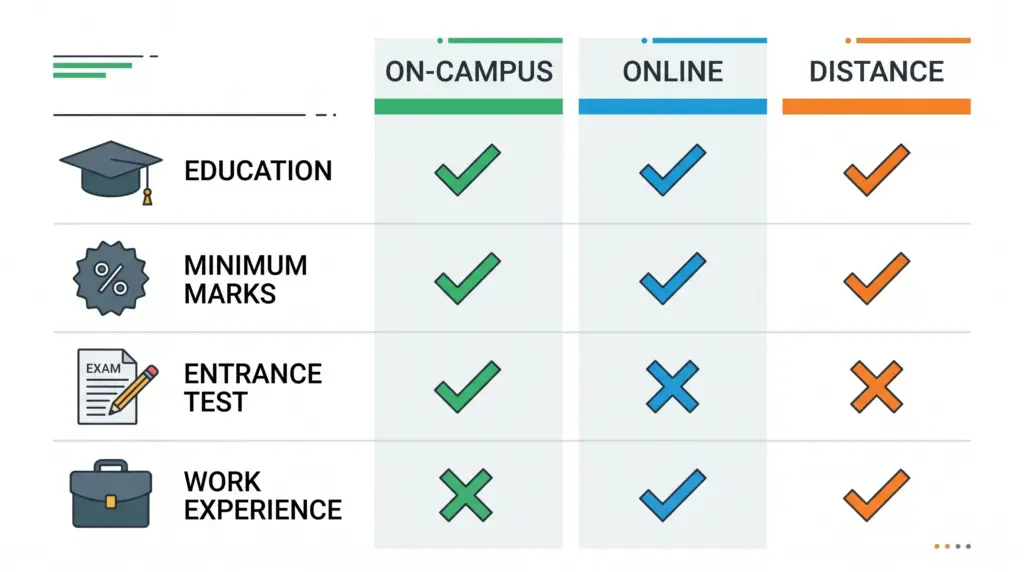
However, when it comes to admission in a certain college, the eligibility criteria are quite similar across all three formats of MBA:
| Criteria | On-Campus MBA | Online MBA | Distance MBA |
| Educational Qualification | Bachelor’s degree from a recognised university (any discipline) | Bachelor’s degree from a recognised university | Bachelor’s degree from a recognised university |
| Minimum Marks | Usually 50% (45% for reserved categories in many universities) | Typically, 45–50%, depending on the university | Usually 45–50%, depending on the university |
| Entrance Exams | Often required (CAT, MAT, XAT, CMAT, GMAT, or university-specific exams), but not compulsory. It depends on the university | Usually not mandatory, but some universities may ask for them | Generally not required |
| Work Experience | Not mandatory, but preferred by top B-schools | Sometimes preferred (1–2 years), but not always required | Usually not required |
| Age Limit | No specific age limit | No age limit | No age limit |
| Admission Process | Optional entrance exam + GD/PI in many institutes | Direct admission or merit-based | Mostly direct admission |
How to Know If Your MBA Degree is Valid or Not?
Doing an MBA is not enough; a valid MBA degree is the key to your career growth, but the real challenge is how you will ensure that your MBA is valid or not.
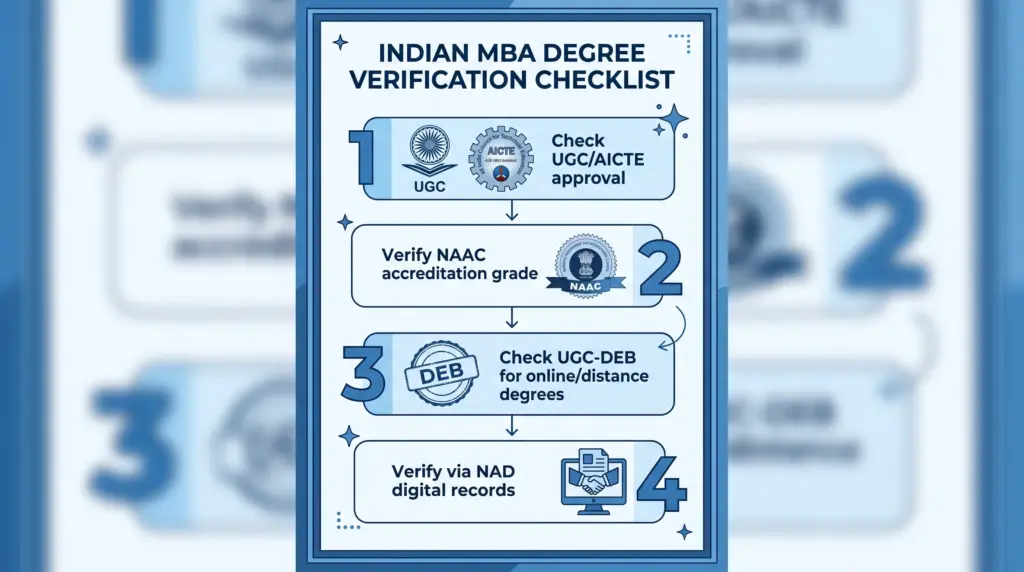
So here are a few steps to check the validity of your MBA degree.
- UGC & AICTE Accredited: The university must be recognised by the University Grants Commission (UGC). For management programs, approval from the All India Council for Technical Education (AICTE) is also crucial for technical validity.
- NAAC Accreditation: Further, check the National Assessment and Accreditation Council (NAAC) portal to see the university’s quality grade.
- Online/Distance Degrees: If you are pursuing an online or distance MBA degree, then check for UGC-Distance Education Bureau (DEB) accreditation for the exact academic session you enrolled in. For a complete breakdown, read our guide on whether online MBA degrees are valid in India.
- Digital and Official Verification Tools: You can also use the NAD portal for checking if the degree has been digitally recorded and verified.
Which MBA Should You Choose? A Decision Framework
Your choice of mode for the MBA might differ, but you need to choose one. However, the real question is which one to choose or which suits you the best.
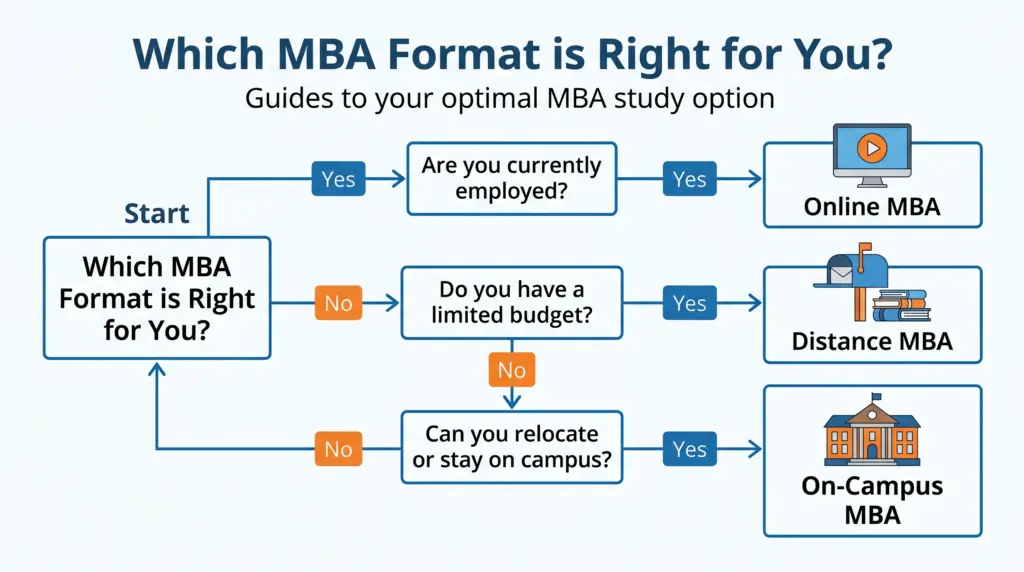
To help you out, experts of CollegeSathi have created a detailed table to compare and look for the best-suited option for you.
| Factor | On-Campus MBA | Online MBA | Distance MBA |
| Best For | Fresh graduates who want a full-time academic experience | Working professionals who want to study while continuing their jobs | Individuals who need maximum flexibility and prefer self-paced learning |
| Learning Format | Classroom-based learning with face-to-face interaction | Live or recorded online lectures through digital platforms | Self-study through study materials and assignments |
| Flexibility | Low - fixed schedules and regular campus attendance | High - flexible schedules with online access | Very High - learn at your own pace |
| Networking Opportunities | Strong - campus events, peer interaction, and faculty guidance | Moderate - virtual networking and online discussions globally | Limited - minimal direct interaction |
| Work While Studying | Usually difficult, as it requires full-time commitment | Easy to manage alongside a full-time job | Possible due to flexible study structure |
| Career Goal | Ideal for starting a career in management or switching fields | Best for career growth, promotions, or skill upgrades | Suitable for gaining a management degree while managing other commitments |
Which MBA is Best for Working Professionals and Fresh Graduates?
An MBA is a key step towards a better career and high-income opportunities. It equips you with leadership and management skills; however, some don’t want to leave their job and pursue an MBA simultaneously. This is why an online MBA is often the best option for working professionals since it offers flexibility, allows you to get an MBA degree while working and also saves you a lot of time. Also, they are equally valid as offline MBA degrees.
If you are a fresh graduate and want to start a professional career quickly, but also want to get an MBA degree, then for you too, an online MBA is the right choice
- Classes, exams, and study material are available online.
- An online MBA is highly flexible; you can learn while working.
- More affordable — top online MBA universities with fees around ₹1 lakh are available across India.
- Ideal for professionals with 0-5 years of experience or those looking for a career switch.
However, if you want a classroom experience, then opting for an offline MBA program is the right choice for you.
Still unsure? Read our in-depth analysis of whether an online MBA is worth it in India before making your final call. However, if you want a classroom experience, then opting for an offline MBA program is the right choice for you.
Final Verdict: Online vs Offline vs Distance MBA
Choosing the right MBA format depends on your career goals. This is something only you can decide based on your goals. Whether you choose an On-Campus, Online, or Distance MBA, they all provide quality learning, career relevance, and career growth opportunities. On-campus programs offer immersive learning and excellent campus placements, whereas online MBAs are flexible and equally recognised, making them an appropriate option for working professionals. Distance MBAs remain a viable and cost-effective option for students who prefer to study at their own pace.
Once you've chosen the format that fits your life, the next step is picking the right specialisation. Read our guide on career paths after MBA and the best specialisations for your goals to continue your planning.
Get Clarity with Us!




Popular PG Programs
Trending UG Programs
Doctorate Programs
Executive Programs
Trending Online Universities
In Demand MBA Specializations
In Demand MCA Specializations
CollegeSathi aims to provide unbiased and precise information to aspirants, along with comparative guidance on universities and their programs. The content on the CollegeSathi website, including text, graphics, images, blogs, videos, and university logos, is meant for informational purposes only and should not be considered a substitute for official information provided by academic partners. While we make every effort to keep the information accurate and up to date, CollegeSathi does not guarantee the completeness or reliability of the content and is not responsible for any errors, omissions, or losses resulting from its use.
© CollegeSathi 2026. All Rights Reserved.