

 ClikPick
 Find Programs
 Top Universities
 ClikPick
 About Us
 Career
 Blogs
Blogs Scholarships


Mukherjee Fellowship – Everything You Need to Know
• Tue Jun 23 2026
In this time of continuous development and transformation of the country, it is very important to develop important policies, governance and establish strong political leadership to maintain speed and growth. If you are interested in gaining real-time exposure in Indian politics, public policy and governance, then you must explore the Mukherjee Fellowship, an innovative platform for emerging changemakers and leaders.
The Mukherjee Fellowship Program is designed for young changemakers who want real-time exposure to Indian governance, parliamentary procedures, and political strategy. With rising interest in fellowships like the CSIR Shyama Prasad Mukherjee Fellowship and growing searches around CSIR SPM fellowship eligibility, candidates are actively exploring top fellowships, and the Mukherjee Fellowship stands out as a leading option in public policy and governance.
This detailed guide covers everything you need to know about the Mukherjee Fellowship Program, including eligibility, benefits, application process, and how it compares with fellowships like the CSIR Shyama Prasad Mukherjee Fellowship.
What Is the Mukherjee Fellowship Program?
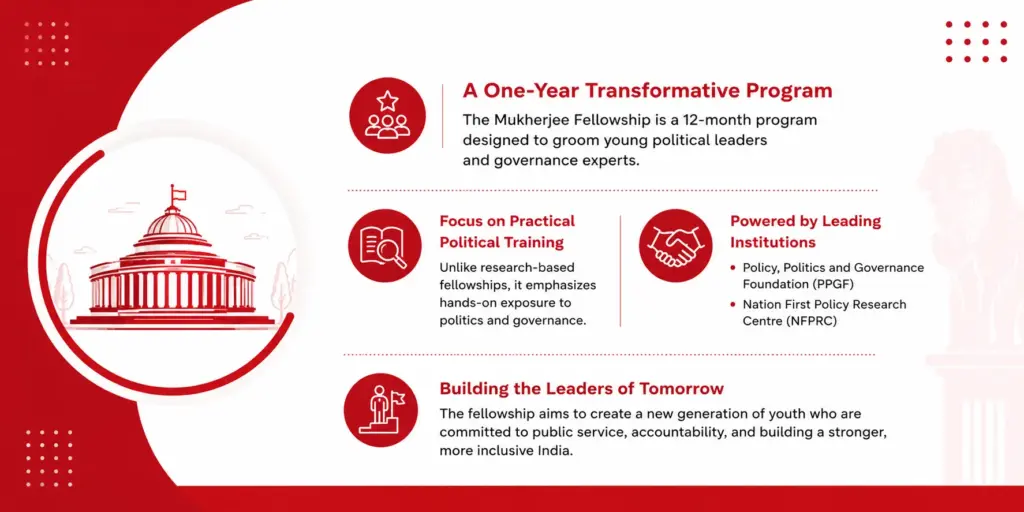
The Mukherjee Fellowship is a premium fellowship of a one-year (12 months) program that aims to help the young minds in the developing countries’ future generation of political leaders and governance experts.
Unlike research-based fellowships such as the CSIR Shyama Prasad Mukherjee Fellowship, which focuses on academic excellence and has strict CSIR SPM fellowship eligibility, the Mukherjee Fellowship focuses on practical political training and governance exposure.
- The Policy, Politics and Governance Foundation (PPGF): This organisation was established to help young minds to develop opportunities in public policy and governance.
- Nation First Policy Research Centre (NFPRC): It is a policy think tank institution which collaborates with policymakers and stakeholders to conduct long-term research on citizen-based policies.
This fellowship prepares the leaders who have the capability of transforming Indian democracy and establishing improvement-based policies and decisions. It represents statesmanship, accountability, and youth empowerment. The main aim of the Mukherjee Fellowship is to create a group of young people who can make policies dedicated to the public to create harmony and transformation within the Indian policy structure.
Why Mukherjee Fellowship is Gaining Popularity in 2026
With this fellowship, you will get the opportunity to explore the political offices, policymaking institutions and campaign situations, allowing you to face the real challenges and government decision-making process. The Mukherjee Fellowship is not just a program, but it's your educational tour, preparing you to become a leader of the future generation.
However, while the CSIR Shyama Prasad Mukherjee Fellowship is ideal for research scholars in science, the Mukherjee Fellowship Program is best suited for students interested in politics, governance, and policymaking careers.
Mukherjee Fellowship Program Structure (2026)
The Mukherjee Fellowship is designed to provide the right combination of theoretical foundations and hands-on exposure so that the learners can gain practical knowledge and empower themselves with the modern approach to making policies according to the dynamics of the country and the world.
This fellowship program is for 12 months, which is divided into two major phases to organise the curriculum effectively for the students. These phases are briefly discussed as:
Phase 1 – Theoretical Training (3 Months)
The first phase of the fellowship shapes the academic core of the students, which includes the theoretical part of the learning. It involves classroom learning, workshops and interactive sessions, which develop in-depth knowledge related to Indian governance, law, politics and public policy. This provides the opportunity for face-to-face interactions, making it useful for the students to gain basic knowledge for policy-making abilities. The 1st Phase is the Theoretical Learning Module, which includes topics like:
- Understanding Indian Society: Analysing political, social, and cultural frameworks.
- Political Campaigns & Communications 101: Strategies for elections, media relations, and voter engagement
- Understanding Parliamentary Procedures: Insights into legislative processes and policymaking.
- Law and Economics in India: Decoding the intersection of governance, law, and fiscal policies.
These sessions are conducted by political leaders, policy analysts, and scholars, providing fellows with access to up-to-date information and guidance.
Phase 2 – Experiential Learning (9 Months)
In these nine months, all your theoretical knowledge will meet the practical actions, where you will visit the offices of parliament and work on real-world situations. You will visit the offices of Members of Parliament (MPs), ministers, think tanks and high-ranking political advisors.
This phase will take you to the physical ground and provide you with the opportunity to practice in real situations and cases. You will learn the real political workflows and apply your modern approach and theoretical knowledge to create impact. You will be placed throughout India as per political offices or institutions of policymaking.
This is an Experiential Learning Module, which will help you get placed on the offices of leading public figures after completing your training. You will gain hands-on exposure to the following:
- Drafting inputs on bills, parliamentary questions, and policy discussions.
- Managing social media and political communications.
- Assisting in election campaigns and constituency strategy.
- Conducting in-depth policy research and legislative analysis.
- Preparing parliamentary speeches and briefings
- Carrying out policy research and white paper preparation
- Working on constituency-level schemes and welfare programs
- Supporting election campaign planning and grassroots outreach
This experiential learning module will prepare you to interact with the real political workforces, learn from public leaders, and observe policymaking, making it the most realistic and practical fellowship in the country to empower political experts.
Why Choose Mukherjee Fellowship?
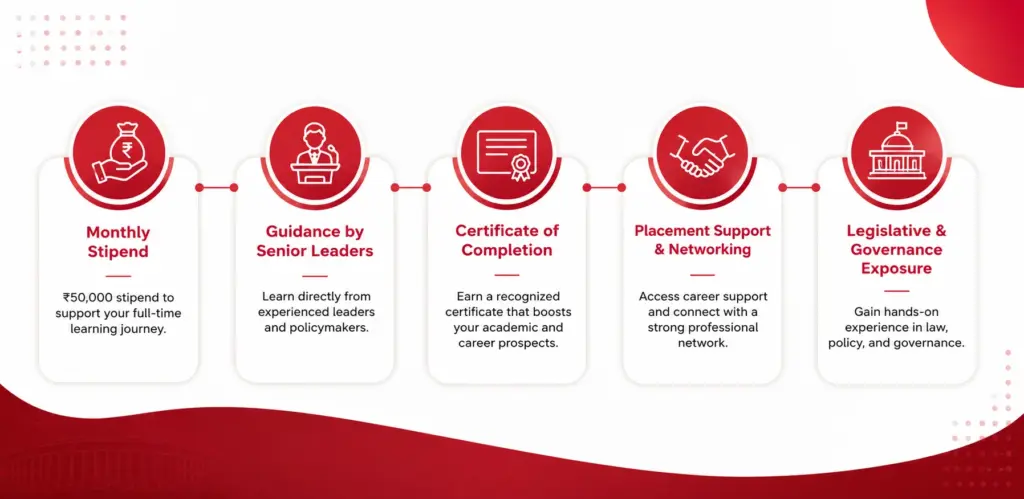
1. Monthly Stipend – ₹50,000: Mukherjee Fellowships also get a monthly stipend of ₹50,000, which is one of the highest monetary benefits provided by fellowships for political and policy training in India. The stipend motivates the students and ensures they work full-time without worrying about money.
This stipend will allow you to concentrate entirely on your studies without worrying about the living costs, study material and other costs related to the fellowship. Here, you can fully focus on study, networking, gaining experience and policy making.
2. Guidance by Senior Political Leaders: The main benefit which you will gain is to get one-on-one training from the senior political leaders, experienced policymakers, and experts in political fields. With them, you will gain deep insights into political processes, strategic choice-making and policy development.
This mentorship will help you to use your theoretical knowledge in practical situations and build critical leadership skills like negotiation, ethical governance, and communication. With this, you will get honest and real feedback, help the fellows to overcome obstacles and make strong connections in political and policy communities.
3. Certification of Completion: At the successful completion of a year-long fellowship, you will be awarded a formal Certificate of Completion that will be recognised as an important credential. The certificate serves as a confirmation of your dedication, skills learned, and applied experience developed in the areas of politics and public policy.
It immensely supports your profile when you seek competitive positions in government institutions, policy think tanks, non-profit foundations, and political consultancies. In addition, it is acknowledged by schools and can be an added advantage, which will support you in advanced studies like a Master's in Public Policy (MPP), Political Science, or similar fields at leading graduate schools around the world.
4. Placement Support & Networking: The Mukherjee Fellowship provides strong placement support and extensive networking opportunities created to facilitate your smooth entry into meaningful careers. You are provided with an active alumni network of professionals who have gone on to build successful careers in various fields of law, policymaking, and governance.
The program provides opportunities for career development through discussions, resume-building and interview classes, and networking opportunities with policymakers, government officials, and private sector professionals who are engaged in political consulting work. This fellowship will directly help you in getting jobs like policy analysts, government advisers, campaign managers, or political strategy firm consultants once you finish the fellowship.
5. Legislative & Governance Exposure: The Mukherjee Fellowship gives direct exposure to legislative activities and governance structures. You will have to work directly with Members of Parliament (MPs), ministries of government, parliamentary committees, or top think tanks that conduct public policy research.
You will experience hands-on engagement involving activities such as writing parliamentary speeches, policy analysis, field work, campaign support for elections, and attending sessions of strategy development.
Such interactive experiences allow you to learn the dos and don’ts of governance from practice rather than theory. Through direct participation in high-impact political activity, fellows acquire irreplaceable experience that equips them to become future leaders in public service.
Mukherjee Fellowship Eligibility Criteria 2026
Understanding eligibility is crucial, especially since many students confuse it with CSIR SPM fellowship eligibility.
- Age Limit: The applicant should be below the age of 25 when applying. Particularly, only individuals born on or after July 1, 2000, are eligible. The fellowship focuses on youth leadership and identifies those who can join the career trajectory early to pursue careers in public service, politics, and governance.
- Nationality Indian Only: Indian citizens are eligible for the fellowship. You will need a valid proof of Indian citizenship (like an Aadhaar card, passport, or voter ID) and submit it during the application process. NRIs or OCI holders cannot apply at this level.
- Educational Qualification: Applicants can be either: Final-year undergraduate students, OR Graduates (B.A/B.Sc./BCA/BBA graduates) in any stream. There is no restriction on the academic stream, which is an indicator of the fellowship's cross-disciplinary approach to political and policy leadership. Students from recognised Indian or international institutions (approved by AIU/UGC) are eligible.
Academic & Professional Background
The Mukherjee Fellowship program encourages students from every professional background, making it accessible to everyone. There is no requirement of prior political or policy background. A good interest in governance, policymaking, political strategy, or public service, however, will be eligible and considered at the time of selection.
Skills You Gain in Mukherjee Fellowship
Through the Mukherjee Fellowship program, fellows build relevant, practical and useful skills. This is what one must have to make a career in politics, as well as governance or public policy.
| Skills | Description |
| Public Speaking and Policy Writing | Fellows are taught how to communicate effectively, both verbally and in writing, and present their ideas to an audience. Their work also involves writing policy briefs, speeches and official letters. |
| Political Communication and Media Strategy | The fellows are taught how to handle political messaging through this fellowship. They do social media packages, campaign messages, and leadership and political communications. |
| Legislative Research and Constituency Mapping | The fellows gain skills in studying laws, following parliamentary discussions, and researching matters of concern. They also assist leaders in planning and outreach at the constituency level. |
| Leadership, Problem-Solving, and Teamwork | The fellowship trains fellows to handle situations, address real problems, and work effectively in small teams. They also operate under pressure, manage various tasks and own projects. |
Mukherjee Fellowship Application Process 2026
The application process for the Mukherjee Fellowship 2026-27 cycle is very straightforward and completely online. It contains some steps, in which candidates will be examined on the grounds of interest, competencies, and knowledge of policy or politics.
Key Dates (Expected)
- Application Opens: May 26, 2026
- Application Deadline: June 22, 2026
- Fellowship Begins: July 17, 2026
Stages for Selection Process
1. Online Application: Interested applicants are supposed to submit an online application. This includes:
- Basic personal information
- Uploading a CV or resume
- Personal Identities
2. Written Assessment: The candidates are expected to take a short test or a written task, which examines their writing ability, analytical skills, and understanding of policy. 3. Final Interview There is a short list of candidates, followed by an interview with the program directors (online or offline). In this round, the attention is paid to:
- Reason/motivation behind becoming a fellowship member.
- Previous experience in leadership
- Communication and thinking clarity
3. Selection: Individuals who excel in the above-mentioned steps are issued an offer letter. Successful fellows will be required to acknowledge the joining procedures before the joining date.
Mukherjee Fellowship vs CSIR Shyama Prasad Mukherjee Fellowship
| Feature | Mukherjee Fellowship | CSIR Shyama Prasad Mukherjee Fellowship |
| Focus | Politics & Policy | Scientific Research |
| Eligibility | Open to all streams | Strict CSIR SPM fellowship eligibility |
| Duration | 12 Months | Multi-year |
| Stipend | ₹50,000/month | Research-based stipend |
| Exposure | MPs, Ministers | Labs & Research |
What to Expect as a Mukherjee Fellowship Student?
The Mukherjee Fellowship involves classroom learning, hands-on work experience, and engagement with leaders in the political field. Each week brings new assignments, activities, and learning experiences that help participants advance in policy and governance. Weekly Responsibilities Generally, students are expected to work five to six days a week, depending on the office to which they are assigned. They are assigned different project work depending on their placement and start work on important projects. Activities may consist of:
- Writing speeches or notes to MPs or Ministers
- Formation of policy briefs or short research reports
- Enabling constituency-related activities
- Social media post management or digital communication
- Participation in team meetings or visits to the field
Past Fellow Projects Examples: Other projects enable individuals to acquire relevant skills and assist in work with the active public. Some of the examples of projects done by past fellows include:
- Budget and parliamentary debate studies
- Campaigning for state elections on social media
- Door-to-door campaign in the country or in the city constituencies
- The education, healthcare and digital governance policy notes
- Composing writing letters, reports or responses to a political leader
Events, Field Exposure & Networking: Fellows participate in networking events, seminars, workshops, and panel discussions with senior political leaders, journalists, and policy experts. These events combine theory and practice. They are also involved in:
- Ministry or constituency field visits
- Gaining experience on the campaign trail during elections
- Socialization with local police and grassroots workers
Work-Life Balance and Learning: The working hours are strict, particularly during periods of parliamentary sessions or election campaigns, and fellows usually work in a high-paced environment. The program is challenging, but it promotes learning by doing, and within several weeks, most of the fellows adapt to it. They are also provided with:
- Peer support and mentor support
- Time to reflect and learn
- An opportunity to cope with work and develop self-discipline
Career Opportunities After Mukherjee Fellowship
The Mukherjee Fellowship supports the career development of young individuals in the fields of public policy, politics, and governance. The fellows gain access to real-world experience, relevant skills, and guidance that prepare them to excel in various positions upon completing the program.
- Work in Political and Government Offices: Fellows assist individual MPs or Ministers and political teams. They help with outreach, policy research, and public speaking. This develops their knowledge of the real-world political and administrative aspects. Build Strong Research and Field Skills: Fellows help in policy studies, field visitations and constituency assistance. They are taught how to study laws, gather local data, and solve problems that concern the population. This prepares them for roles in governance and public policy.
- Start a Career in Consulting or Political Strategy: Following the program, many fellows join consulting firms, political advisory teams, or campaign groups. They engage in online strategy, data research and communication. The fellowship is a pathway for a career in political consultancy.
- Step into Advanced Policy Degrees: Other fellows may even pursue master's degrees in public policy, law, or political science. Their applications and profiles are submitted by the fellowship on their behalf. It serves as a gateway to undergraduate and postgraduate studies in leading Indian and international universities.
- Stay Connected Through a Strong Alumni Network: Fellows become part of a community that supports alumni who are involved in politics or policy. This community exchanges jobs, recommendations and projects. It could assist fellows to develop beyond the program.
The Mukherjee Fellowship Program opens doors that traditional fellowships like the CSIR Shyama Prasad Mukherjee Fellowship may not provide in governance careers.
How Does It Compare to Other Fellowships?
| Fellowship | Duration | Focus | Focus | Description |
| Mukherjee Fellowship | 12 Months | Politics & Policy | ₹50,000 | It combines public policy training with real political work |
| LAMP Fellowship | 11 Months | Legislative Research | ₹23,000 | This focuses only on working with one MP on parliamentary research |
| Gandhi Fellowship | 23 Months | Education Leadership | ₹24,500 | It is based in rural areas, works for school and system change |
| India Fellow | 18 Months | Social Development | ₹15,000-22,000 | This involves working with NGOs, mainly in rural development roles |
Conclusion
If you are passionate about politics, governance, or policymaking, the Mukherjee Fellowship Program is your gateway to a powerful career. While fellowships like the CSIR Shyama Prasad Mukherjee Fellowship are excellent for research, the Mukherjee Fellowship provides unmatched real-world exposure in Indian politics. So, if you want to step into the world of policymaking, build leadership skills, and create real impact, this is the opportunity you should not miss.
If you want to know more about the Mukherjee fellowship program, then getting in touch with a CollegeSathi expert will be a right next step for you.
Get Clarity with Us!




Popular PG Programs
Trending UG Programs
Doctorate Programs
Executive Programs
Trending Online Universities
In Demand MBA Specializations
In Demand MCA Specializations
CollegeSathi aims to provide unbiased and precise information to aspirants, along with comparative guidance on universities and their programs. The content on the CollegeSathi website, including text, graphics, images, blogs, videos, and university logos, is meant for informational purposes only and should not be considered a substitute for official information provided by academic partners. While we make every effort to keep the information accurate and up to date, CollegeSathi does not guarantee the completeness or reliability of the content and is not responsible for any errors, omissions, or losses resulting from its use.
© CollegeSathi 2026. All Rights Reserved.