

 ClikPick
 Find Programs
 Top Universities
 ClikPick
 About Us
 Career
 Blogs
Blogs Scholarships


New UGC Guidelines for Online Degrees in 2026: What Students Must Know
Academic Guidance • Mon Jul 06 2026
A clear, student-first guide to online degree rules, approvals, and safe enrolment in India.
Quick Answer

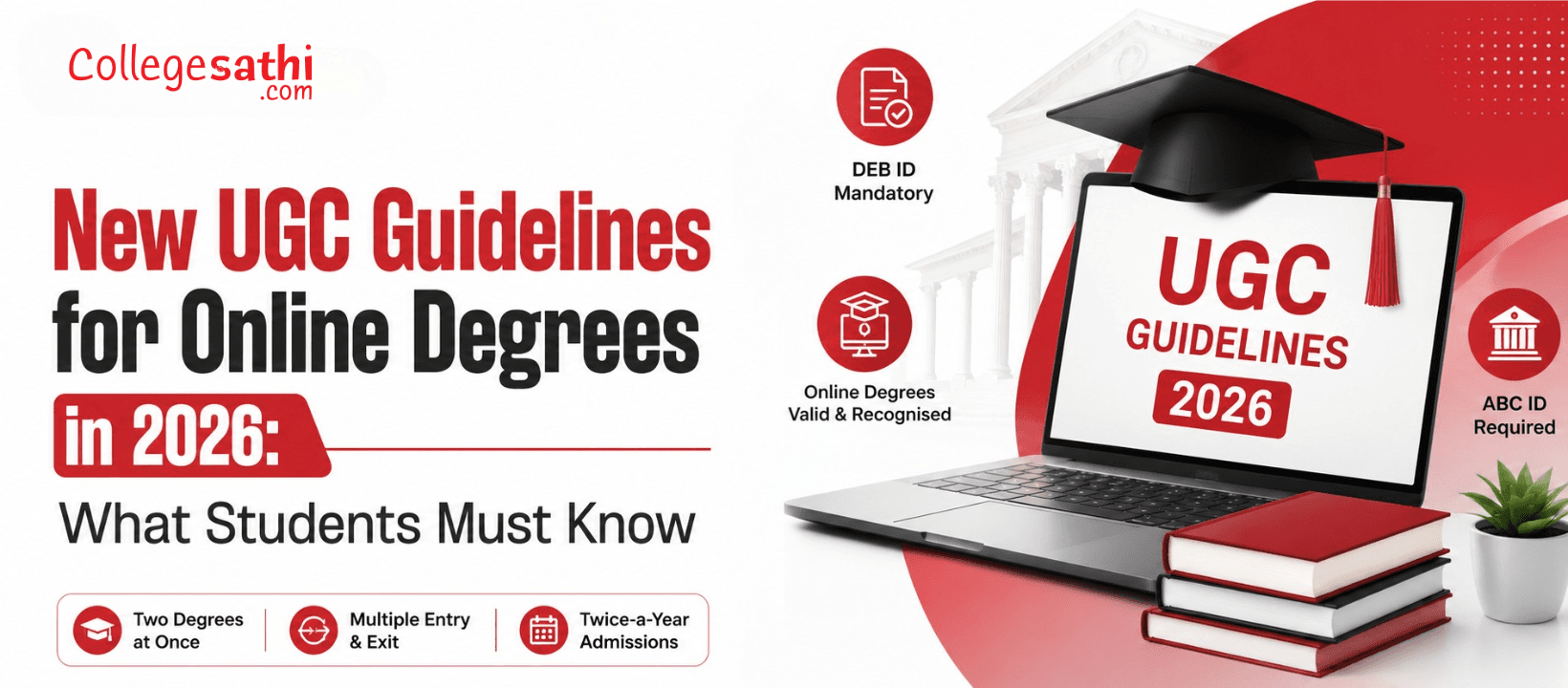
Online degrees in India are fully valid in 2026 — but only when the university and your exact course hold current UGC-DEB approval. The biggest changes this year: a DEB ID is now compulsory at admission, your marks are tracked through the Academic Bank of Credits (ABC), some practical-heavy subjects cannot be taught fully online, and you can now study two degrees at once. Always check your program on deb.ugc.ac.in before you pay any fees.
Online learning in India has grown at a rapid pace, and the rules around it keep evolving. If you plan to join an online degree in the 2026-27 session, a few key updates could shape your choice. The University Grants Commission (UGC), through its Distance Education Bureau (DEB), has refreshed how online and distance programs are approved, tracked, and recognised.
This guide breaks down the new UGC guidelines in plain language. You will learn what changed, which subjects are allowed online, how to spot a genuine university, and the exact steps that protect the value of your degree.
Who sets the rules? UGC and the DEB explained
The UGC is the main body that oversees higher education in India. Within it sits the Distance Education Bureau (DEB), which handles online and distance programs. Every university that offers an online degree needs a separate DEB entitlement — a general UGC licence is not enough on its own.
Here is the point most students miss: approval is granted session by session and course by course. A university may be approved for an online MBA but not for a BCA. It may be approved for 2025-26 but still awaiting clearance for the next year. So the name alone never tells the full story.

Are online degrees valid in India in 2026?
Yes. A UGC-DEB approved online degree carries the same legal standing as a regular, on-campus degree. The UGC made this clear in its 2020 notification. The Supreme Court backed it in 2022, ruling that an employer cannot reject a candidate only because the degree was earned online or through distance mode — as long as the institution is UGC recognised.
There is one condition that decides everything: the university and your specific program must appear on the UGC-DEB approved list for the year you enrol. As of 2026, 113 institutions are entitled to run online programs, together offering more than 750 courses at UG and PG levels. A smaller group of recognised institutions adds several dozen more.
Want the finer detail on recognition, government jobs, and higher study? Our full guide on whether an online degree is valid in India breaks it down step by step.
Key UGC changes for online students in 2026
Here is a quick snapshot of what is new this year and why it matters to you:
| What changed | What it means for you |
|---|---|
| DEB ID is mandatory | You must create a DEB ID before your admission counts as complete. |
| ABC ID is required | Your marks are stored as credits in an Academic Bank of Credits account. |
| Some subjects restricted | Practical or clinical fields cannot be taught fully online. |
| Two degrees at once | You may study two programs together, subject to a few conditions. |
| Multiple entry and exit | You can leave and rejoin without losing credits, for up to seven years. |
| Twice-a-year admissions | Universities can admit students in two cycles: July–August and January–February. |
These updates sit within a wider set of reforms. For the bigger picture, see our overview of the major changes introduced by UGC across Indian higher education.
DEB ID and ABC ID: the two IDs you now need
Two digital IDs sit at the heart of the 2026 rules. You will hear about both during admission, so it helps to know what each one does.
ABC ID (Academic Bank of Credits)
Think of the ABC ID as a bank account for your marks. It is a unique 12-digit number. Every credit you earn is deposited into it. You can transfer these credits between recognised universities or redeem them later for a degree. Credits stay valid for up to seven years. You create the ID free of cost at abc.gov.in using your DigiLocker or Aadhaar details.
DEB ID
The DEB ID is issued by the Distance Education Bureau for distance and online learners. It links to your ABC ID and follows your academic record across modes of study. From the 2025-26 session onward, an admission is treated as incomplete without it.
Simple safety tip

If an online university does not ask for your ABC ID or DEB ID during admission, treat that as a warning sign. Genuine institutions follow this step every time.
Which subjects cannot be studied fully online?
Not every course can be delivered online. The UGC restricts subjects that need hands-on training, lab work, or clinical practice. The table below shows the general picture.
| Usually allowed online / ODL | Restricted from fully online mode |
|---|---|
| BBA, BCA, B.Com, BA | MBBS and other medical degrees |
| MBA, MCA, MA, M.Com | Nursing and allied health sciences |
| Data Science, Commerce, Arts | Pharmacy and practical-heavy fields |
| Management and Computer Applications | Lab-based engineering programs |
One more point worth noting: online PhD programs are not permitted. A doctorate still needs campus presence and active research supervision, so no university can offer a fully online PhD.
More flexibility: credit transfer and multiple entry-exit
The 2026 framework is built around student choice. The Multiple Entry and Exit system lets you step out of a course and return later without starting over. Leave after the first year with a certificate, or after the second with a diploma, then come back and finish when life allows. Your credits wait safely in your ABC account for up to seven years.
Credit transfer works alongside this. If you move to a new university, your earned credits can move with you. One rule to remember: you must earn at least half of your credits from the university that awards your final degree. Credits from national platforms like SWAYAM can also count toward your total.
Can you study two degrees at the same time?
Yes. Since April 2025, the UGC allows students to pursue two full-time programs together. You can combine them in two ways:
- Two online degrees together, or
- One regular (campus) degree and one online or distance degree.
The main condition is simple: the class and exam timings must not clash. This opens real options. For example, you could finish a campus degree while starting an online one to build a second skill for your career.

Why these 2026 rules work in your favour
At first glance, more rules can feel like more hurdles. In practice, these changes protect you as a learner. Here is how each one helps:
- Stronger trust. Session-wise approval keeps weak or fake programs out, so your degree holds its value.
- No lost effort. The ABC system saves your credits, so a break in study no longer wipes out your progress.
- Real flexibility. Two-degree and multiple entry-exit options let you shape learning around work and life.
- Clear equivalence. An approved online degree is treated the same as a campus degree for jobs and higher study.
In short, the new system rewards planning. A little care at the start gives you a credential you can rely on for years. That is a fair trade for a few extra steps during admission.
How to check if an online university is UGC approved
Verifying a university takes only a few minutes, and it can save you years of effort and money. Follow these five steps in order:
- Visit the official portal. Go to deb.ugc.ac.in. This is the only authoritative source. Avoid third-party lists.
- Open the recognised HEI list. Look for “Entitled Institutions for Online Programmes” or the current approved list.
- Search your university and your course. Approval is program-specific, so check the exact course, not just the name.
- Confirm the session. Make sure your program is approved for your admission year, 2026-27.
- Cross-check the university site. A genuine institution displays its UGC-DEB approval openly.
Many well-known online universities meet these standards. Popular UGC-DEB approved choices include NMIMS Online, Manipal University Online, Chandigarh University, and Amity University Online, each offering a wide range of UG and PG programs. For a wider list with fees and accreditation details, browse our roundup of the top UGC approved online universities in India.
Red flags to avoid
Some offers look attractive but hold no real value. Stay away from any program that:
- Promises a full degree in “one sitting,” “one year,” or “fast-track.”
- Advertises a “distance B.Tech” — this is not UGC approved.
- Runs only through a franchise or a third-party agent.
- Charges surprisingly low fees for a complete degree.
- Does not appear on the deb.ugc.ac.in list.
- Cannot share a UGC-DEB approval letter with an approval number.
Your before-you-enrol checklist
Run through this short list before you pay any fees. If every answer is a clear yes, you are on safe ground.
- Is the university on the current UGC-DEB approved list?
- Is your exact course approved for the 2026-27 session?
- What is the NAAC grade? An A++, A+, or A points to strong quality.
- Have you created your ABC ID and DEB ID?
- Does the online syllabus match the regular one in content and credits?
- Are the fees, duration, and student support explained clearly?
- For an online MBA, is AICTE recognition in place where needed?

What about foreign and dual degrees?
The UGC's 2025 rules on foreign qualifications make it simpler and faster to get an overseas degree recognised in India. This helps NRIs and students returning home, with a clearer timeline and an online application route. Indian institutions can also team up with approved foreign universities to offer twinning, joint, and dual degree programs. If a global credential is part of your plan, these routes are worth exploring.
Final word
The 2026 UGC guidelines make online degrees more transparent, flexible, and trustworthy than before. The rules reward students who do one simple thing: verify before they enrol. Confirm your university and course on deb.ugc.ac.in, create your ABC and DEB IDs, and match the program to your career goal. Do that, and your online degree will stand shoulder to shoulder with any campus degree.
Ready to take the next step?

Compare UGC-DEB approved universities, courses, and fees — and get guidance that fits your goals — on CollegeSathi. Choose with clarity and confidence.
Get Clarity with Us!




Popular PG Programs
Trending UG Programs
Doctorate Programs
Executive Programs
Trending Online Universities
In Demand MBA Specializations
In Demand MCA Specializations
CollegeSathi aims to provide unbiased and precise information to aspirants, along with comparative guidance on universities and their programs. The content on the CollegeSathi website, including text, graphics, images, blogs, videos, and university logos, is meant for informational purposes only and should not be considered a substitute for official information provided by academic partners. While we make every effort to keep the information accurate and up to date, CollegeSathi does not guarantee the completeness or reliability of the content and is not responsible for any errors, omissions, or losses resulting from its use.
© CollegeSathi 2026. All Rights Reserved.