

 ClikPick
 Find Programs
 Top Universities
 ClikPick
 About Us
 Career
 Blogs
Blogs Scholarships


Understanding NIRF Rankings: Significance, Impact, and Future Scope
• Mon Jul 06 2026
The National Institutional Ranking Framework (NIRF) India is a government initiative aimed at ranking and grading higher education institutions in India based on predetermined performance parameters. As Indian students go in search of quality education in increasing numbers, the NIRF ranking list acts as a sure-shot benchmark for rating colleges and universities. Focusing on basic areas like the standard of teaching, research publication, student achievement, and inclusiveness, NIRF encourages institutions to compete for excellence and innovation in the highly competitive education market.
With its systematic ranking approach, NIRF has changed how institutions assess their development and sustain quality. These rankings impact not only the student's choice, but also funding, institutional standing, and policy formulation. By evaluating prominent parameters and promoting transparency, NIRF drives institutions to improve their teaching and research abilities.
This blog will discuss the basics of NIRF ranking in India, its ranking in the list process, and why NIRF ranking is so important in determining India's future in higher education.
NIRF Full Form & Meaning: What is NIRF Ranking?
The NIRF full form is National Institutional Ranking Framework, which was launched through the Ministry of Education (MoE previously known as MHRD), Government of India, in 2015 to provide a common method for evaluating higher educational institutions. NIRF ranking in India operates through universities and NIRF ranking colleges in India, which follow transparent performance indicator evaluations that maintain an organized assessment procedure.
NIRF ranking universities in India achieves effective student choice decisions by combining assessment indicators for educational quality, research output, and student achievement to enable institutions to discover their weak areas. The system maintains a competitive education environment that forces universities to advance educational quality and research potential, together with campus facilities.
Why NIRF Ranking is Important for Students & Colleges
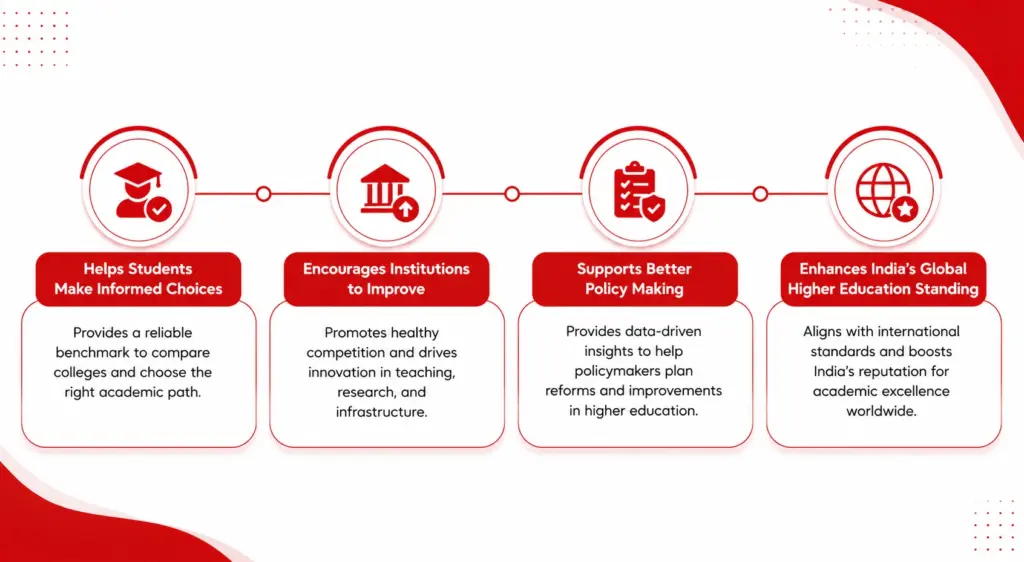
The Indian education sector used to follow the traditional standards for measuring the credibility of universities and colleges in India. This deficiency left the students at a loss to make decisions, the institutions unable to gauge their improvement, and the policymakers at a loss to detect areas of improvement. Realizing this, the NIRF ranking of universities in India was brought into being to:
- Give students an honest benchmark on which to decide colleges, a transparent tool they can use to make informed choices about their academic future.
- Properly encourage the institutions to upgrade educational quality through NIRF ranking in India, promoting competition, which would drive innovation in teaching quality, research deliverables, and infrastructure.
- Support policymakers to develop education policies, providing fact-based insights that support NIRF ranking colleges in India, which led to reform and specific improvements.
- Reinforce India's international image of excellence in higher education, positioning Indian institutions better on the global map by making them conform to international ranking methodologies and encouraging excellence in academics.
NIRF Ranking Methodology: How Colleges Are Ranked in India
The NIRF evaluation process determines institution performance through five core sections totaling 100 points.
Teaching, Learning & Resources (TLR) – 30% Weightage
The educational quality offered by an institution serves as the main subject for evaluation in this metric. The evaluation system examines academics through the lens of faculty expertise, along with teaching staff numbers and the availability of academic facilities comprising libraries and labs, and additional educational resources.
The following section explains these sub-parameter NIRF ranking evaluation criteria in detail:
- Faculty-Student Ratio (FSR) (20 Marks): Measures student-to-instructor proportions needed for proper academic guidance.
- Faculty Qualifications & Experience (FQE) (30 Marks): Evaluates both the number of Ph.D. possessing faculty members and their combined years of academic teaching experience.
- Library & Laboratory Facilities (LL) (40 Marks): Evaluates the investment made in books, along with journals and digital resources, and laboratory infrastructure.
- Sports & Extracurricular (SEC) (10 Marks): Validates the availability and encouragement of sports, together with cultural activities and co-curricular opportunities.
Research & Professional Practice (RP) – 30% Weightage
This parameter evaluates an institution’s research output, industry collaborations, and technological advancements. Below are the sub-parameters to it:
- Research Publications (30 Marks): Recognizes the volume and quality of research papers published in reputed global journals.
- Citation Impact (30 Marks): Examines the influence of research by analyzing citation metrics.
- Patents & Technology Transfer (20 Marks): Assesses the number of patents filed, granted, and commercialized.
- Funded Research Projects (20 Marks): Considers the financial grants and sponsorships secured for research initiatives.
Graduation Outcome (GO) – 20% Weightage
The success rate of students includes graduating from their programs as well as finding employment or pursuing further education studies. Here are its sub-parameters in detail:
- University Examinations (40 Marks): Evaluates the percentage of students who pass with distinction.
- Higher Studies & Employability (40 Marks): Tracks the number of graduates pursuing further education or gaining employment.
- Median Salary (20 Marks): Assesses the average salary packages of graduates as an indicator of institutional credibility.
Outreach & Inclusivity (OI) – 10% Weightage
An institution’s true dedication toward diverse student populations forms the basis of this evaluation metric. The sub-parameters will be detailed in the following paragraphs.
- Regional & Social Diversity (30 Marks): Examines the representation of students from different states and economic backgrounds.
- Women’s Representation (30 Marks): Measures the percentage of female students and faculty members, promoting gender diversity.
- Differently Abled Facilities (20 Marks): Evaluates infrastructure and provisions for students with disabilities.
- Scholarships & Financial Aid (20 Marks): Assesses the availability and effectiveness of financial assistance programs.
Perception (PR) – 10% Weightage
This metric gauges an institution’s reputation among academia, employers, and the public.
- Academic Reputation (50 Marks): Reflects peer recognition and ratings from other institutions.
- Employer Reputation (50 Marks): Measures employer feedback and industry perception based on surveys.
NIRF Ranking List: Top Colleges & Universities in India
| Name of the Institution | NIRF Score | NIRF Ranking |
| Manipal University | 67.18 | 4 |
| Amrita Vishwa Vidyapeetham | 65.73 | 7 |
| Chandigarh University | 59.96 | 19 |
| Amity University | 56.14 | 32 |
| Dr. D. Y. Patil Vidyapeeth | 54.59 | 44 |
| Narsee Monjee Institute of Management Studies (NMIMS) | 52.43 | 49 |
| Sharda University | 46.88 | 86 |
Why do NIRF Rankings Matter?
Benefits for Students
- Informed Decision-Making: NIRF rankings provide students with a clear and data-driven means of comparing colleges on the basis of important performance indicators.
- Academic and Research Insights: By measuring institutions based on aspects such as faculty quality and research productivity, students are better able to understand the learning environment.
- Enhanced Credibility: Well-placed institutions in NIRF become more trusted and reputable, hence more attractive to prospective students and families.
- Improved Job Opportunities: Getting a degree from a top-ranking school usually means improved job offers and better pay.
Advantages for Institutions
- Encourages Academic Excellence: Institutions are motivated to improve faculty quality, research, and student outcomes to secure higher rankings.
- Boosts Institutional Reputation: A strong ranking enhances an institution’s national and global standing, attracting talented students and faculty.
- Access to Better Funding: Higher-ranked institutions often receive more grants, sponsorships, and government support for research and development.
- Enhanced Industry Collaboration: Companies and organizations prefer collaborating with well-ranked institutions for recruitment, internships, and joint research initiatives.
Significance for Policymakers
- Policy Design and Enhancement: NIRF rankings offer significant information that assists in formulating and enhancing higher education policies.
- Monitoring Educational Standards: The system of ranking makes it possible to monitor institutional improvements and determine institutions that require adjustment.
- Facilitating Fair Competition: By ranking colleges on uniform metrics, NIRF fosters fair competitive spirit for quality enhancement.
- Enhancing India's International Educational Image: Institution building through rankings enhances India's education system's competitiveness on the global front.
How NIRF Ranking Impacts Higher Education in India
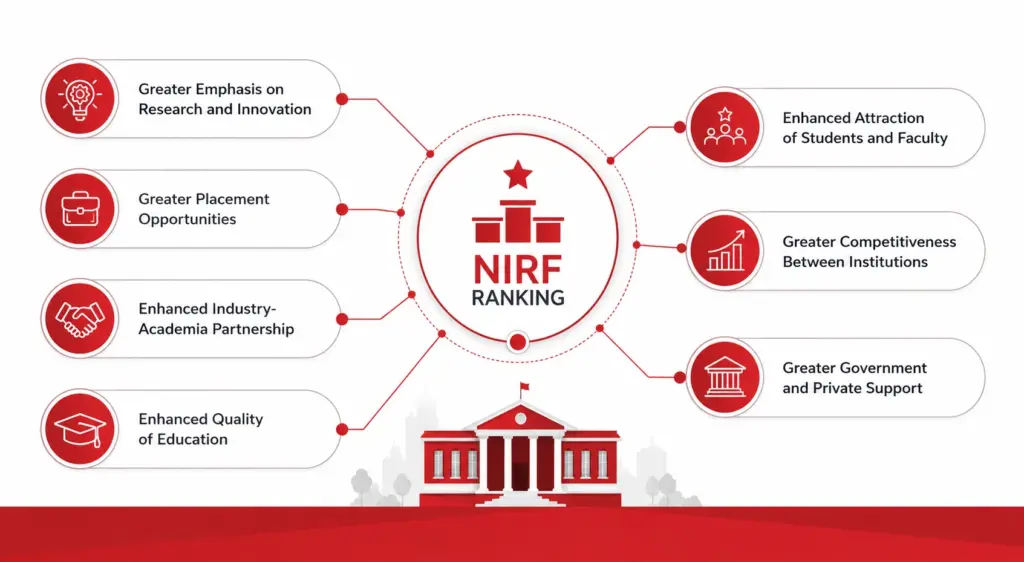
Indian higher education institutions have oriented their strategic direction through the influence of the NIRF ranking in India. The framework has generated multiple important outcomes because institutions attempt to boost their placement.
- Greater Emphasis on Research and Innovation: Teachers, along with students at universities, dedicate more resources to research facilities, which serves as motivation to conduct groundbreaking research and innovation.
- Greater Placement Opportunities: The employment prospects of students keep improving since both colleges and universities strengthen their network with industries by developing better placement services. Graduates benefit from better employment prospects by attaining a higher ranking in NIRF.
- Enhanced Industry-Academia Partnership: Education institutions partner with industries to conduct sponsored research, alongside giving students internships, which leads to an improved learning process focused on real-world applications.
- Enhanced Quality of Education: Institutions rush to achieve top NIRF status through activities that include improving curriculum development as well as teaching methods alongside faculty training programs.
- Enhanced Attraction of Students and Faculty: The attraction of quality students and talented faculty members improves when institutions achieve better ranks which subsequently advances academic achievement.
- Greater Competitiveness Between Institutions: Institutions have started offering a wide range of development programs, such as online learning, teacher training, and student services, to rise in the rankings competition.
- Greater Government and Private Support: Public institutions maintaining high positions in NIRF tend to draw more support from both government bodies and private donors, leading to institutional development.
Challenges in the NIRF Ranking System
While the NIRF ranking system has brought transparency and standardization to higher education assessments, it also faces several challenges:
- Data Manipulation Risks: Some institutions may inflate or misreport data to improve their rankings, affecting the credibility of the system.
- Overemphasis on Research Metrics: The ranking framework heavily weighs research publications and citations, which may disadvantage institutions focusing more on teaching excellence.
- Limited Consideration for Humanities and Social Sciences: The current ranking parameters favor STEM (Science, Technology, Engineering, and Mathematics) fields, making it difficult for arts and humanities institutions to perform well.
- Lack of International Benchmarking: While NIRF ranks institutions within India, it does not align directly with global ranking standards, limiting its international credibility.
- Variability in Perception Scores: The perception metric, based on surveys from peers and employers, can be subjective and influenced by institutional branding rather than actual quality.
- Unequal Weightage for Emerging Institutions: Established institutions have a historical advantage, making it challenging for newer universities to break into top ranks despite innovation and quality improvements.
How Colleges Can Improve Their NIRF Ranking
The NIRF framework requires institutions to work on the following multiple key areas to get better ranking results:
- Enhance Research Output: Institutional research output increases when faculty members publish their work in prestigious journals, along with students who file patents while participating in funding programs, so the Research and Professional Practice (RP) category scores better.
- Improve Teaching and Learning Standards: Strict standards in teaching and learning practices will be achieved through hiring accomplished faculty members, along with maintaining sensible faculty-to-student ratios and building appealing academic facilities for improved Teaching Learning Resource (TLR) scores.
- Strengthen Graduation Outcomes: Educational institutions must dedicate their efforts to enhancing student graduation performance while raising employment success and graduation placement achievement. The partnership with local industries through internships and recruitment opportunities positively affects the Graduation Outcome (GO) scores.
- Increase Diversity and Inclusivity: The scores of Outreach & Inclusivity (OI) will grow when educational institutions embrace diversity through regional and gender balancing, alongside providing financial backing to needy students while fostering environments that accommodate students with disabilities.
- Enhance Perception and Branding: Understanding industry leaders and academic peers can achieve better Perception (PR) scores through collaborative activities, which also build institutional reputation.
- Adopt Digital Learning Strategies: An institution can boost its rankings by adopting digital learning methods, which include implementing online learning platforms alongside offering MOOC-based courses while using digital educational tools.
Conclusion: The Future of NIRF Ranking in India
The NIRF ranking process has transformed the Indian higher education sector, offering a standardized and transparent system for measuring institutional performance. It has motivated colleges and universities to improve academic standards, research output, and infrastructural strength. For students, NIRF is an important decision-making instrument, providing information about an institution's weaknesses and strengths.
For universities and colleges, it serves as a touchstone for ongoing improvement, assisting them in recruiting the best faculty, students, and finances. Policymakers also gain from the rankings, using them to improve education policies and promote national academic excellence.
Even with its merits, NIRF rankings are plagued by issues like risks of data manipulation and requirements for greater discipline-specific weightages. Nevertheless, with continued improvements, it can become even more credible and effective. In the long term, NIRF will act as a key driver in determining India's educational institutions, making them globally competitive while maintaining high academic standards.
Conclusion
The NIRF ranking process has transformed the Indian higher education sector, offering a standardized and transparent system for measuring institutional performance. It has motivated colleges and universities to improve academic standards, research output, and infrastructural strength. For students, NIRF is an important decision-making instrument, providing information about an institution's weaknesses and strengths. For universities and colleges, it serves as a touchstone for ongoing improvement, assisting them in recruiting the best faculty, students, and finances. Policymakers also gain from the rankings, using them to improve education policies and promote national academic excellence.
Even with its merits, NIRF rankings are plagued by issues like risks of data manipulation and requirements for greater discipline-specific weightages. Nevertheless, with continued improvements, it can become even more credible and effective. In the long term, NIRF will act as a key driver in determining India's educational institutions, making them globally competitive while maintaining high academic standards.
Get Clarity with Us!




Popular PG Programs
Trending UG Programs
Doctorate Programs
Executive Programs
Trending Online Universities
In Demand MBA Specializations
In Demand MCA Specializations
CollegeSathi aims to provide unbiased and precise information to aspirants, along with comparative guidance on universities and their programs. The content on the CollegeSathi website, including text, graphics, images, blogs, videos, and university logos, is meant for informational purposes only and should not be considered a substitute for official information provided by academic partners. While we make every effort to keep the information accurate and up to date, CollegeSathi does not guarantee the completeness or reliability of the content and is not responsible for any errors, omissions, or losses resulting from its use.
© CollegeSathi 2026. All Rights Reserved.