

 ClikPick
 Find Programs
 Top Universities
 ClikPick
 About Us
 Career
 Blogs
Blogs Scholarships


Online Education vs Distance Education: Benefits and Limitations
• Fri Jul 03 2026
Technology has become a new trend in every industry, business, and even in people's personal lives. The education industry has also accepted technology, so everyone can get an education from any corner of the world, anytime. Traditional education is no longer the only option for learning and personal growth.
With tech-savvy features, online and distance education have become more popular modes of education. In today’s fast-changing education landscape, online education and distance learning have become powerful alternatives to traditional classroom learning. But many students still ask: what is a distance learning course?, what is a distance degree?, and most importantly, is distance education valid or not?
This blog will help you understand the detailed pros and cons of each mode of education so you can make an informed decision about your educational journey.
What is Online vs Distance Learning?
Online Learning
Online education is a modern learning mode in which students access educational content and interact with instructors with the help of the Internet. It is delivered through virtual and digital platforms, like online or live classes, webinars, or guest lectures.
Key Features of Online Education:
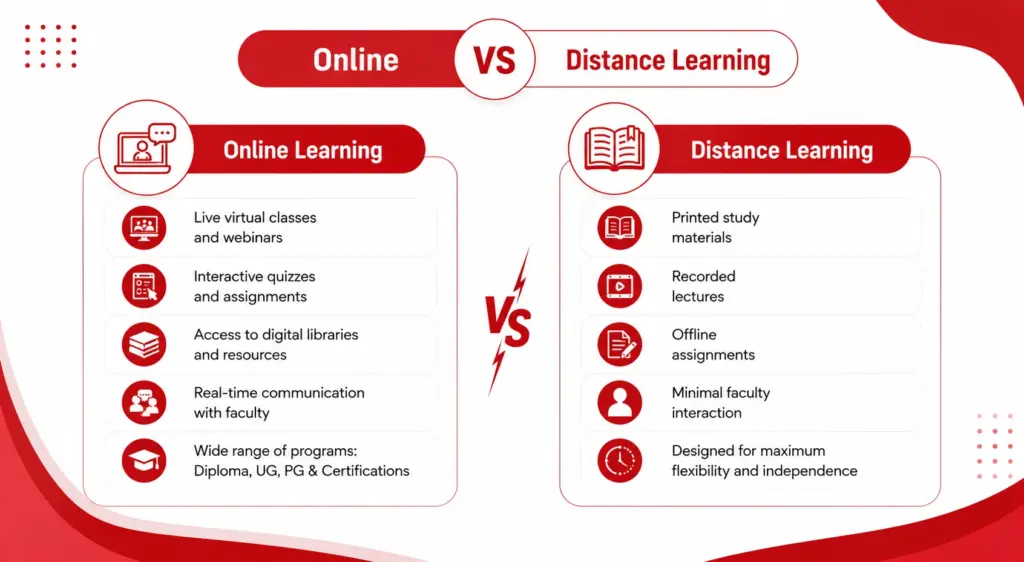
- Live virtual classes and webinars
- Interactive quizzes and assignments
- Access to digital libraries and resources
- Real-time communication with faculty
Most importantly, the key feature of online education is that today, students can pursue Diploma, UG, PG, and certification programs through online education via top universities of India, such as NMIMS Online, LPU, Chandigarh Online University, Amity Online, Manipal Online University, and many more. The key courses include:
- MBA (Marketing, Finance, HR, Business Analytics)
- BBA & BCA programs
- Data Science and AI certifications
- Cybersecurity and Cloud Computing courses
Distance Learning
Distance Education, also known as correspondence learning, is a mode of learning where students do not attend physical classes and interact with the instructor. This method enables individuals to pursue education without the need to participate in traditional on-campus courses. Under this mode of education, the primary goal is to provide education to those who need flexibility due to work, family, or other priorities.
Distance learning relies on:
- Printed study materials
- Recorded lectures
- Offline assignments
- Minimal faculty interaction
This method is designed for students who need maximum flexibility and independence.
Difference Between Online and Distance Learning
Both online and distance education seem similar; however, they are quite different. To make the difference between online and distance learning more transparent, here is a quick comparison:
Difference Between Online and Distance Learning
Both online and distance education seem similar; however, they are quite different. To make the distinctions more transparent, here is a quick comparison:
| Aspect | Online Education | Distance Education |
| Mode of Delivery | It is entirely internet-based and involves virtual classrooms, multimedia content, and live interactions. | It mainly uses physical materials such as textbooks, CDs, or DVDs, with minimal or no use of the internet. |
| Interaction Level | This mode of education offers high interaction through live sessions, discussion forums, and real-time Q&A with professors and peers. | Under this mode of education, interaction is limited or nil, focusing on self-paced study without direct communication. |
| Flexibility | Online education provides flexible schedules but includes some fixed deadlines for assignments, quizzes, or live sessions. | Distance education is extremely flexible, allowing students to complete coursework at their own pace. |
| Technology Dependence | Online education requires stable and proper internet access. The student must have digital devices like laptops or tablets and have basic knowledge of online tools. | Distance education can be pursued with minimal or no use of technology, which makes it accessible in areas where there is less digital or internet connection. |
| Learning Format | It is very Interactive and engaging and uses multimedia material like videos, animations, and quiz-like content. | It provides self-paced materials and focuses on traditional learning materials such as printed books, CDs, or recorded lectures. |
| Access to Resources | Online education provides access to digital libraries, online labs, and other virtual resources. | Distance education only relies on physical materials, with limited or no additional resources. |
| Cost | This type of education is typically more expensive due to technological requirements and other platform costs. | This type of education is more affordable as it does not require technology. |
| Assessment Methods | The assessment or evaluation is done on the basis of online quizzes, proctored exams and real-time feedback on assignments. | The assessment or evaluation is done on the basis of written assignments and offline exams, with delayed feedback. |
| Target Audience | Online education is Ideal for tech-savvy learners, working professionals, and those who value interaction and engagement. | Distance education is best suited for learners in remote areas or with limited internet access and for those who prefer self-paced study. |
Pros and Cons of Online Education
The advantages of online education make it one of the fastest-growing learning modes:
- Flexibility and Convenience: The key advantage of online learning is that it is accessible to students at any time and from anywhere, even with busy schedules like jobs or family responsibilities, because of the exquisite feature of flexibility.
- Affordable: When comparing the pros and cons of online education, online education wins since the courses and degree programs offered in online learning are at a very minimal cost, almost half due to the savings on travelling, hostel, and other physical learning materials.
- Variety of Programs: Another advantage of online education includes a wide range of programs, such as graduate programs, postgraduate programs, certificate programs, and advanced degrees that might not be available in on-campus education.
- Self-Paced Learning: Most online courses allow students to learn according to their schedule and ability, which is useful when they may require more time to work on concepts or have other commitments.
- Access to Global Expertise: Under this mode, a learner will interact with professors as well as other students from any part of the world, and this allows great opportunities to connect with experts across fields.
- Technology Integration: An online course often acts as a great learning source since it includes different multimedia tools, such as videos, interactive quizzes, and forums.
For example, programs like online MBA in Business Analytics, Data Science, or Digital Marketing are in high demand and widely available through online platforms.
Many students today explore these programs through Collegesathi, which simplifies comparing universities and finding the right fit based on career goals.
Disadvantages of Online Education
- Requires a stable internet connection
- Screen fatigue from long sessions
- Self-discipline is essential
- Limited physical interaction
Pros of Distance Education
The advantages of distance education are especially valuable for students who need flexibility.
- Variety of Learning Methods: Distance education advantages include a mix of online materials, physical textbooks, and recorded lessons to provide education from different places.
- Reduced Geographical Barriers: Distance education advantages enable students to pursue courses or different programs offered by universities from different cities, regions, and countries without needing to relocate.
- Wider Accessibility: Another advantage of distance education allows students to study in remote or rural areas where universities/institutes are unavailable.
- Self-discipline and Time Management: Distance learning helps in adopting discipline, as the student has to manage their time and complete their assignment as per the deadline given by the university.
- Access to a Wide Range of Learning Materials: Students can often download lectures, notes, and other resources for study, which can be accessed multiple times for review and revision.
Online Education vs Distance Learning: Which One Should You Choose?
Online education is perfect for tech-savvy learners interested in an interactive platform to improve their learning abilities. It also helps professionals collaborate with the instructor and classmates. Most of all, online education suits a person with a good internet connection because learning can be done through online courses and material access anywhere at any time.
Distance education is ideal for those with limited internet access or those who prefer the old learning method. It helps students to stay in remote areas where an online education infrastructure might not be available. Also, distance education suits those who choose to study alone without needing live interaction with others.
Both the education styles and modes provide different benefits and advantages. In this case, you face difficulties and confusion in choosing the most suitable mode for you. As a solution for this problem, the following are the factors that can provide you with clarity:
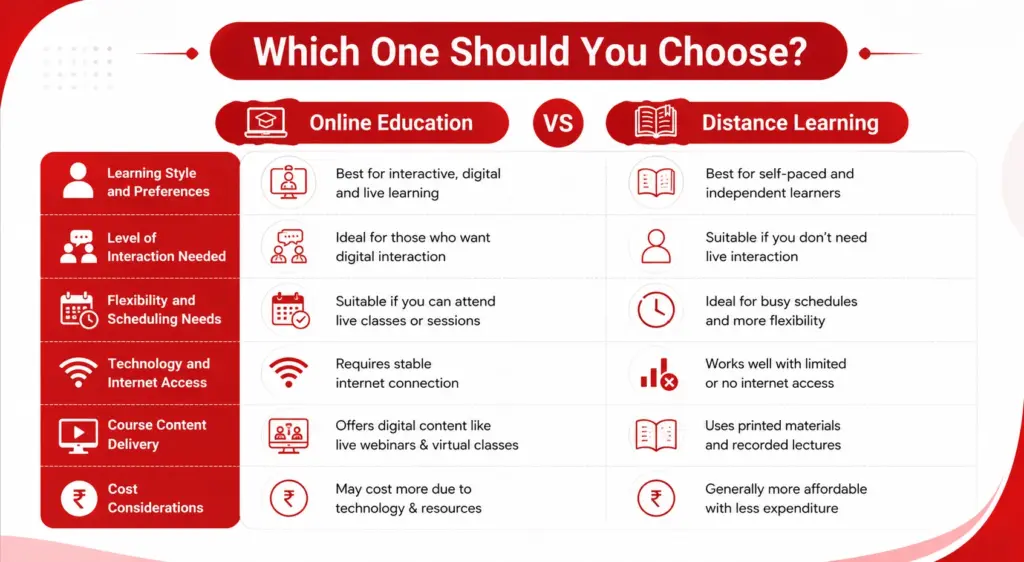
- Learning Style and Preferences: If you prefer interactive, digital, and live learning experiences, you must opt for an online mode of education. But if self-paced and independent is your learning style, you must opt for distance education.
- Level of Interaction Needed: Online learning is an ideal choice if you want digital interaction with professors or classmates. But if you don't need such interaction, distance learning is a better choice.
- Flexibility and Scheduling Needs: If you have time to attend the live classes or sessions, you can choose an online mode of education. But if you have a busier schedule and want more flexibility, you must select a distance mode of education.
- Technology and Internet Access: If you live in a place where you can have a stable internet connection, then online education is good for you. But if you live in rural areas where it is difficult to have a stable internet connection, then you must choose the distance mode.
- Course Content Delivery: If you are interested in digital content like live webinars, interactive multimedia, online discussions, and virtual classrooms, then online education is a perfect match for you. But if you like printed materials or recorded lectures, then distance education is an ideal match for you.
- Cost Considerations: If you can afford the cost of technological services, then go for online mode, but if you expect less expenditure, then distance education is the best fit for you.
Are Online vs Distance Degree Recognised and Valid
One of the most important concerns for students today is degree validity and recognition. Many still question: distance education is valid or not? or whether online education degrees hold the same value as traditional ones.
The answer is Yes, online education degrees and distance learning degrees are valid in India, if they meet the following criteria:
- The university is approved by UGC (University Grants Commission)
- The program is recognised by UGC-DEB (Distance Education Bureau)
- The degree is offered as per government guidelines
- Exams and assessments meet regulatory standards
Online degrees from recognised universities are now widely accepted globally for:
- Private sector jobs
- Government exams (in most cases)
- Higher education (Master’s or PhD programs)
Many students make the mistake of skipping this step, which can impact future career opportunities. This is why proper guidance from a Collegesathi expert will help you make the right decision.
Conclusion
Understanding the difference between online and distance learning is essential before making an educational decision. Technology has taken over all industries and improved the quality of learning, giving way to more comfort and ease. Both online education and distance education offer interesting benefits.
Be it a tech-oriented learner who prefers constant and proper study interaction or someone who would instead study independently at their own pace without needing an internet connection, both options provide the opportunity to develop, improve, and progress in their career.
In the end, both modes offer great benefits; the approach that works most effectively is the one that suits your purpose, learning style, and particular life situation. You will get quality education through both education modes. You must explore your goals and objectives to find an ideal education path that is right for you!
Don’t let distance or time hold you back. Start your learning journey today!
Smart tip for learners
Instead of researching multiple university websites, many learners now prefer platforms like Collegesathi to compare only verified and recognised online and distance programs in one place, saving time and avoiding confusion.
Get Clarity with Us!




Popular PG Programs
Trending UG Programs
Doctorate Programs
Executive Programs
Trending Online Universities
In Demand MBA Specializations
In Demand MCA Specializations
CollegeSathi aims to provide unbiased and precise information to aspirants, along with comparative guidance on universities and their programs. The content on the CollegeSathi website, including text, graphics, images, blogs, videos, and university logos, is meant for informational purposes only and should not be considered a substitute for official information provided by academic partners. While we make every effort to keep the information accurate and up to date, CollegeSathi does not guarantee the completeness or reliability of the content and is not responsible for any errors, omissions, or losses resulting from its use.
© CollegeSathi 2026. All Rights Reserved.