

 ClikPick
 Find Programs
 Top Universities
 ClikPick
 About Us
 Career
 Blogs
Blogs Scholarships


Top Finance Project Ideas for Career Growth: From Investment to FinTech

Career Development • Thu Jul 02 2026
If you're a finance student or professional seeking to improve your finance skills, working on the best finance project topics is the best way to improve or learn about finance. Theories and textbooks indeed provide a good foundation, but finance is about numbers, trends, and decision-making in current, fast-changing, and dynamic contexts.
A successful finance project for MBA students will provide you with hands-on experience in financial investment strategies, risk management, corporate finance, and emerging technologies such as FinTech. Think about assessing how stock market volatility affects investment portfolios, looking at an organization's financial health and overall risk, or understanding how AI is changing the way we approach fraud detection.
These trending finance topics are not just good projects that you can put on your resume; instead, they are life experiences that will prepare you for financial scenarios in the real world. Today's employers want people who can show they have actual experience, not just academic experience.
Therefore, whether you are a finance student preparing for a future in finance or you are already a finance professional looking to gain some skills in finance, working on meaningful finance projects can really set you apart. Now, let's explore the value that finance projects bring to your career.
Why Finance Projects Are Important for Career Growth
Finance projects are either structured projects or research-based assignments that allow students or practitioners to use finance theories in a real-world financial case. Finance projects, such as project-based or portfolio analysis, vary greatly by their complexity, so, you could evaluate an investment portfolio or evaluate the effect of economic policy on the financial market.
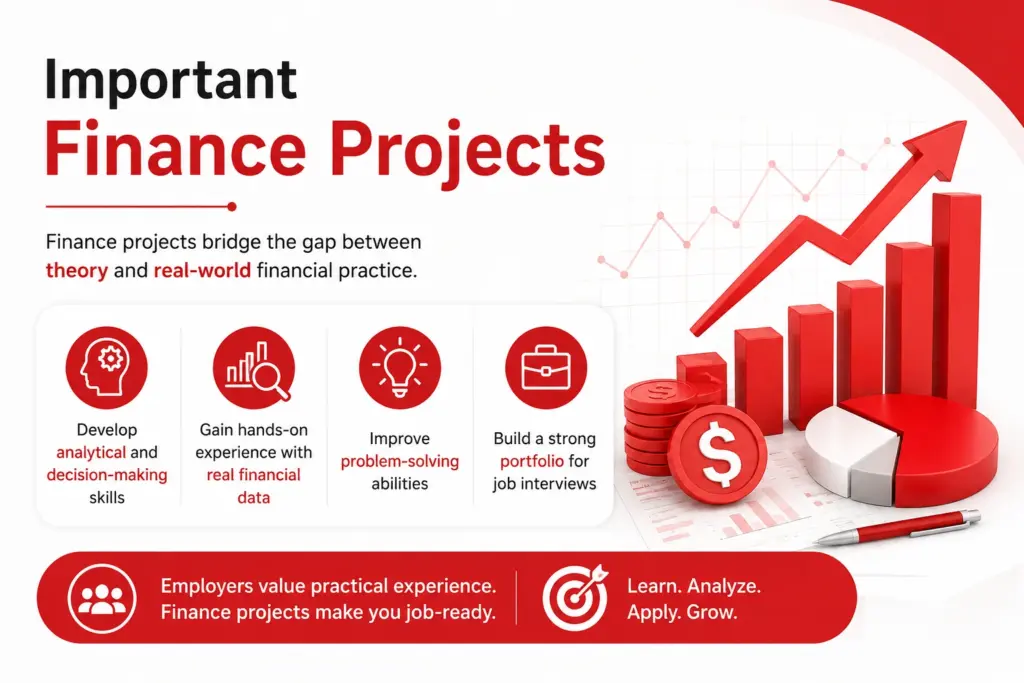
Projects serve a purpose whether you are in school for academic credit or developing your technical analysis skill from a self-interest or career interest perspective, they allow financial students or practitioners to bridge the gap between theory and practice.
Working on finance projects for MBA students enables you to:
- Develop analytical and decision-making skills
- Gain hands-on experience with real financial data
- Improve problem-solving abilities
- Build a strong portfolio for job interviews
Employers today prefer candidates who have worked on real-world MBA finance projects, not just theoretical concepts.
How do Finance Project Ideas Help in Understanding Real-World Financial Scenarios?
Finance is more than math; it is about making rational decisions based on sizable market factors and activity expectations related to business and profit costs. Producing hours of finance projects helps both students and practitioners become more acquainted with the courses and professional applications of complex finance topics and coursework projects. For example, forecasting stock prices using historical data or evaluating a company's valuation using financial models gives hands-on exposure to industry practices.
Key Areas Covered in Finance Project Topics
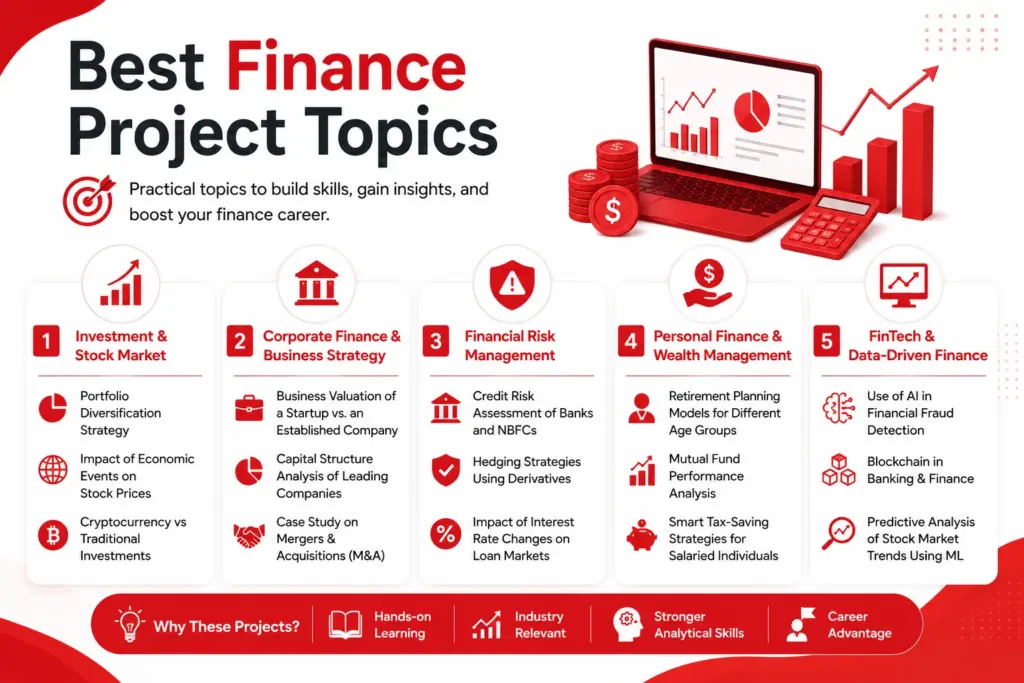
Finance projects cover a broad array of topics, including:
- Investment & Stock Market Analysis – Experience utilizing stock performance, portfolio diversification, and asset allocation.
- Corporate Finance – Demonstrating an analysis of the respective capital structure of a company, or conducting due diligence with respect to the respective mergers or acquisitions of the firm, and a standalone firm valuation.
- Risk Management – It helps identify and mitigate financial risks, aspiring to hedge or achieve no-risk or solvency measurement.
- FinTech & Data Science in Finance – Using AI, blockchain, and big data to improve financial decision-making.
- Personal Finance & Wealth Management – Identifying tax-saving tactics, retirement funding, and financial advisory.
Role of Finance Projects in Skill Development and Career Growth
- Problem-solving skills development: Excellent implementation of finance projects will boost your ability to solve problems, analyze situations, and make decisions, which elevates your marketability to employers.
- Job preference: Companies prefer job applicants who bring abilities to implement financial models and understand both data analysis and make strategic business decisions from authentic financial situations. Financial projects teach students step-by-step methods to resolve business issues that find applications in corporate finance and investment banking, together with financial consulting.
- Portfolio diversification: Working with portfolio diversification strategies builds your knowledge about risk management, whereas conducting business valuation analysis strengthens your assessment ability of company performance. Business projects in finance develop skills that enhance confidence regarding financial decisions, thereby helping you prepare for future leadership positions. You turn theoretical concepts into real-life application experience through practical scenario implementation of financial lessons.
How to Choose the Right Finance Project?
Selecting an appropriate finance project is essential to maximize your learning experience and elevating your career. A selected project supports your understanding of the financial tools and concepts while also being useful for future employers. Here are some important items to think about before selecting your finance project:
Does it align with your career path? Choose the trending finance topics which should also relate to the field of finance that interests you the most, whether it is investment analysis, corporate finance, risk management, derivatives, or FinTech. You should select a project in the same field that you are targeting to get practical experience. For example:
- If you want a career in investment banking, a finance project on business valuation or M&A case studies would include practical experience.
- If you are interested in risk management, you could do a finance project on hedging strategies using derivatives as a project.
- If you love FinTech, select a topic like AI in fraud detection or blockchain in finance.
Industry Trends and Relevance Finance, as a field, is always changing, and keeping up with the trends in finance is vital to your success. If you undertake finance projects for MBA students that relate to currently trending topics in finance, you can add greater value to your work and contribute to your research insights. The following are several examples of trending topics in finance:
- Cryptocurrency and blockchain finance
- ESG (Environmental, Social, and Governance) investing
- Applications of machine learning to financial forecasting
- The impact of government regulations on banking and finance
Availability of Data and Research Material A good finance project topic will require reliable data that you can look at and assess or analyze for findings. Before you decide on a project topic, be sure that you can access data and information that relates to the financial topic for your work. Sources could include:

- Stock Market Data: NSE/BSE, Yahoo Finance, Bloomberg
- Financial Statements of companies: Moneycontrol, official reports, and investor relations pages
- Government and regulatory reports: RBI, SEBI, World Bank
- Industry reports and academic research papers: Google Scholar, Statista.
Best Finance Project Topics List for Students (2026)
Let’s discuss some fun finance project ideas that can contribute to hands-on experience and develop analytical skills. We will begin with Investment & Stock Market Projects, one of the most popular areas of finance.
1. Investment & Stock Market Projects
Investment and stock market projects can help students learn about market behavior, risk management, and portfolio optimization. Investment and stock market projects are highly application-oriented and will benefit people interested in investment banking, financial analysis, or wealth management.
(i). Portfolio Diversification Strategy Objective
Compare different types of assets such as stocks and bonds, mutual funds, real estate, and cryptocurrencies to analyze risk-return tradeoffs. Why is it important? The project will support your understanding of how diversification works to mitigate investment risk and maximize returns. Key steps:
- Collect historical return data for various asset classes.
- Calculate risk (i.e., standard deviation) and return (i.e., compound annual growth rate) for each asset.
- Use principles of diversification like Modern Portfolio Theory (MPT) to analyze optimal asset allocation.
- Present findings about the best diversification strategy based on levels of risk tolerance.
(ii). Impact of Economic Events on Stock Prices
Aim: Explore the effects of inflation, recessions, global crises, or government policies on stock market trends.
Why is it relevant? Knowing how markets react to economic events is very important to traders, investors, and financial analysts.
Key steps:
- Select a major economic event, for example: COVID-19, interest rate changes, or the Russia-Ukraine war.
- Select a few companies or stock indices, for example: NIFTY 50 or S&P 500.
- Examine the stock price changes before, during, and after the event.
- Identify patterns in trading volumes and investor sentiment.
(iii). Cryptocurrency vs Traditional Investments
Aim: Compare the risk and return characteristics of cryptocurrencies and traditional asset classes over the past 5 years.
Importance: In light of the growing prevalence of digital assets, an important consideration for investors is whether or not cryptocurrencies are a viable investment to hold.
Key steps:
- Collect price data for Bitcoin, Ethereum, and major stock indices, for example: NIFTY 50 or S&P 500.
- Examine the risk-adjusted metrics, average return metrics, and volatility using the Sharpe Ratio metric.
- Examine investment performance across a number of different market conditions, for example, bull and bear phases.
- Provide insights into the view of cryptocurrencies as a reliable alternative to traditional investments.
2. Corporate Finance & Business Strategy Projects
Through corporate finance, companies learn to handle financial resources while deciding on investments and building the best possible capital structure. The projects will give you practical training for careers, including financial consulting, together with investment banking and corporate finance management.
(i). Business Valuation of a Startup vs. an Established Company
The research aims to evaluate the assessment processes that startups and mature organizations use for valuation purposes. The process of entity appraisal plays an essential role throughout investment banking activities, corporate finance operations, and venture capital assessment.
Key steps:
- The project requires selecting a developing FinTech startup as the startup along with Infosys or Reliance, as the established firm.
- The valuation process should utilize DCF and P/E Ratio alongside EBITDA multiples analysis for a complete evaluation.
- Examine the monetary differences between startup valuations and established firms, then study startup-exclusive risk elements.
- Identify the most suitable valuation technique for different types of business enterprises.
(ii). Capital Structure Analysis of Leading Companies
This study explores the optimal methods that organizations use to distribute debt and equity to increase their financial results. Knowing capital structure allows businesses to make better financing decisions as well as evaluate financial stability.
Key steps:
- Firms representing different business sectors, such as IT and pharmaceuticals, as well as manufacturing should be selected for comparison.
- The capital structure of these organizations should be examined through financial ratio analysis of the Debt-to-Equity Ratio and the Interest Coverage Ratio.
- Compare financing strategies and their impact on profitability and risk.
- Professional advice should be given regarding optimal capital structure designs for different industrial sectors.
(iii). Case Study on Mergers & Acquisitions (M&A)
Analyze the success or failure of a high-profile M&A deal. The importance stems from M&A operations that influence business expansion, along with market control and financial system stability.
Key steps:
- One notable M&A case will serve as the subject of analysis (select from Facebook’s WhatsApp purchase or Tata’s Air India acquisition or Disney’s Marvel takeover).
- The evaluation includes an analysis of both financial results before the merger alongside results following the merger completion.
- Analyze the impact on stock prices, market competition, and financial synergies.
- Identify key success factors or reasons for failure.
3. Financial Risk Management Projects
To minimize risks and achieve financial stability, organizations need proper management of their risks as a fundamental financial responsibility. These educational projects enable students to learn multiple approaches for risk assessment, together with various hedging methods and credit risk evaluation systems.
(i). Credit Risk Assessment of Banks and NBFCs
The main task involves evaluating credit risk levels in banks and Non-Banking Financial Companies through assessments of loan default patterns and implementation of risk control measures. Credit risk assessment stands as a necessity for financial institutions because it helps organizations recover loans while preserving their profitability. Key steps:
- Examine three banks along with three NBFCs, including SBI alongside HDFC Bank and Bajaj Finance.
- The analysis includes examination of asset non-performing ratios as well as default rate data and funding provisions established by these institutions.
- Analyze the risk exposures between financial institutions and analyze their techniques for risk management.
- Propose strengthened approaches for institutions to handle their credit risk better.
(ii) Hedging Strategies Using Derivatives
The research investigates the manner through which financial derivatives such as futures, options, and swaps enable businesses to reduce their financial exposure. The importance of hedging emerges because it enables organizations to defend against market price swings and currency volatility and interest rate variations.
Key steps:
- University programs introduce different derivative instruments for risk management purposes.
- For this assignment choose a company which employs derivatives by exploring its use of fuel price hedges like airlines do.
- Companies should evaluate how their hedging techniques work to decrease financial risk exposure.
- The article evaluates hedging and speculation approaches whereas it explores effective strategies to manage financial risks.
(iii). Impact of Interest Rate Changes on Loan Markets
The research investigates the effect which interest rate fluctuations create on financial market borrowing and lending processes. The interest rate system directly affects all banking loans while it controls mortgage costs and corporate funding sources. Key steps:
- The variation of RBI Repo Rates throughout the past years needs observation.
- Study how modifications in interest rates affect the expansion rates of bank loans.
- Evaluate how home, personal and business loans can be impacted by increasing or decreasing rates.
- Describe how financial decisions on interest rate fluctuations can be adjusted by businesses or individuals.
4. Personal Finance & Wealth Management Projects
Wealth management through personal finance assists people by developing financial strategies and defining investment approaches, as well as tax optimization practices, to reach their monetary intentions. These projects deliver substantial value to individuals who want to work in financial advisory and wealth management as well as personal investment planning.
(i). Retirement Planning Models for Different Age Groups
The main goal is to create multiple investment plans suitable for millennials and Gen X members, and boomers, which guarantee retirement money security. The proper planning of retirement has essential importance because each age group needs different financial strategies for security.
Key steps:
- The retirement planning approaches that include Systematic Investment Plans (SIP), Provident Fund (PF), and National Pension System (NPS) should be identified.
- Assess the capabilities of people from different age groups to accept risks.
- Restate to develop unique financial planning approaches that cater to people in their three specific age groups: 20s, 40s, and 60s.
- The financial advisor should give actionable advice to people about how they can achieve financial security after retirement.
(ii). Mutual Fund Performance Analysis
The research completes an evaluation of actively managed mutual funds against passive index funds to ascertain their performance returns. The understanding of mutual fund performance creates essential knowledge needed for investors to select better investment options.
Key steps:
- A study will examine both actively managed funds, such as SBI Bluechip Fund and HDFC Equity Fund, and index funds with the NIFTY 50 Index Fund and S&P 500 ETF.
- Historical returns data and expense ratio performance information, with risk-adjusted measures such as the Sharpe Ratio and Alpha, need a thorough analysis.
- Choose the investment fund that demonstrates more favorable long-term profitability.
- Strategies should be provided to determine the appropriate situations where investors need to choose between actively managed funds and passive investments.
(iii). Smart Tax-Saving Strategies for Salaried Individuals
Salaried professionals require an examination of tax-minimized investment opportunities alongside financial planning techniques to discover. Tax planning yields substantial importance for savers because it enables them to obtain higher financial savings and boost their available funds.
Essential Steps:
- Investors should identify tax saving opportunities from the Income Tax Act under sections 80C, 80D and 10(10D) which allow equity linked savings schemes, a public provident fund and national pension scheme investments.
- Compare the tax efficiency of different investments in terms of returns, for example, Fixed deposits vs. ELSS Mutual Funds.
- Consider tax saving measures and their impact on long-term wealth accumulation.
- Provide suggestions based on respective income levels for the most tax-efficient investment portfolios.
5. FinTech & Data-Driven Finance Projects
The technology of FinTech, including: enables changes to happen in the financial sector through artificial intelligence systems, as well as blockchain technologies and digital payment methods. The initiatives will enable learners to investigate how modern technology supports financial decision systems while improving risk evaluation processes across the detection of fraudulent activities.
(i). Use of AI in Financial Fraud Detection
The analysis investigates artificial intelligence (AI) together with machine learning (ML) techniques, which banking institutions use to detect fraudulent financial transactions. Financial institutions use AI-driven models to identify suspicious activities, which helps prevent fraud incidents from rising due to their growing concern.
Key steps:
- Understand how artificial intelligence detects fraud during work with financial institutions through analyzing UPI, Paytm, Razorpay, and similar payment platforms.
- The study needs to investigate the three main fraud detection approaches, consisting of pattern recognition, irregular detection, and transaction monitoring systems.
- The analysis of financial transactions to detect fraud should use Python or R programming languages.
- Integrate examples of artificial intelligence implementations that strengthen both online banking and payment systems' security.
(ii). Blockchain in Banking & Finance
The research goal evaluates blockchain technology as it transforms banking institutions and modifies payment procedures and financial operations. The importance of blockchain technology arises from its ability to boost financial service security through transparent operations and its elimination of internal and external intermediaries while fighting fraud.
Key steps:
- Describe blockchain core principles combined with its position in Decentralized Finance (DeFi), Smart Contracts, and cryptocurrency systems.
- Study case examples of blockchain adoption in banking (e.g., JP Morgan’s blockchain-based payment system).
- Compare how blockchain technology produces advantages when compared to established financial operations.
- Discuss the key obstacles and barriers that prevent blockchain from becoming successful in standard financial operations.
(iii). Predictive Analysis of Stock Market Trends Using Machine Learning
A goal exists to use historical data for developing stock market trend predictions through machine learning artificial intelligence models. ML-based predictions enable stock investors and traders to improve their decision making by indicating stock price movement patterns.
Essential Steps:
- Access stock market data from either the NSE, BSE, or global indices that include the S&P 500.
- Model market patterns using machine learning models, for example linear regression, decision trees and neural networks.
- Visualising and interpreting the results of predictions developed using python or R or Excel.
- Assess the accuracy of the model by assessing the predictions of ML against the real stock market trends.
Conclusion
Students pursue finance-related projects as practical solutions instead of traditional academic work, which leads them to address real issues in financial problem-resolution. Financing projects help you acquire essential analytical thinking and critical skills that your career demands through the investigation of both investment strategies, corporate finance, risk management, and FinTech advancements.
Working on these topics exposes you to real-world financial analysis methods, which help you evaluate economic trends and deliver critical decisions exactly as finance professionals do in professional practice. These projects deliver clear advantages when you seek employment in investment banking or financial consulting as well as in personal wealth management fields because they improve your interview performance and practical skill sets at work.
Your success depends on selecting an interesting topic and then conducting thorough research before learning from this valuable experience. At Collegesathi, we encourage students and working professionals to choose industry-relevant finance projects that align with their career goals and help them gain hands-on experience. The right project can enhance your understanding of financial concepts while building a strong portfolio for future opportunities.
Get Clarity with Us!




Popular PG Programs
Trending UG Programs
Doctorate Programs
Executive Programs
Trending Online Universities
In Demand MBA Specializations
In Demand MCA Specializations
CollegeSathi aims to provide unbiased and precise information to aspirants, along with comparative guidance on universities and their programs. The content on the CollegeSathi website, including text, graphics, images, blogs, videos, and university logos, is meant for informational purposes only and should not be considered a substitute for official information provided by academic partners. While we make every effort to keep the information accurate and up to date, CollegeSathi does not guarantee the completeness or reliability of the content and is not responsible for any errors, omissions, or losses resulting from its use.
© CollegeSathi 2026. All Rights Reserved.